
How We Elected the American President – that’s the title of a political thriller by Macedonian writer and columnist Aleksandar Kukulev. A provocative one, to be sure – referencing events that shook the world far beyond tiny North Macedonia, a country the average American probably wouldn’t even be able to locate on a map… at least not until the 2016 election.
Trump and the fake news farm
The small town of Veles hit international headlines even before Americans cast their votes. The Guardian and BuzzFeed News described it as the world’s largest “fake news factory.” The story began like a quirky indie film: a few teenagers from Veles, with basic English skills, created websites that pushed anti–Hillary Clinton content. Instead of diet tips or sport news, political posts brought them real money.
They started out with harmless clickbaits: diet tips, lifestyle, car reviews. These light topics attracted visitors to their websites. And the pages were packed with ads, each click from users worth a few cents. So these young Macedonian entrepreneurs stayed up late, learning how to generate and redirect traffic to their sites.
But soon they discovered that that neither cars, nor health, nor the romances of celebrities stirred emotions as much as politics did. Sensational headlines, fabricated quotes, even invented criminal cases — drew much more traffic.
And as it soon became clear, the views and beliefs of one political group were easier to monetize than others.
US Election and Macedonian Teens
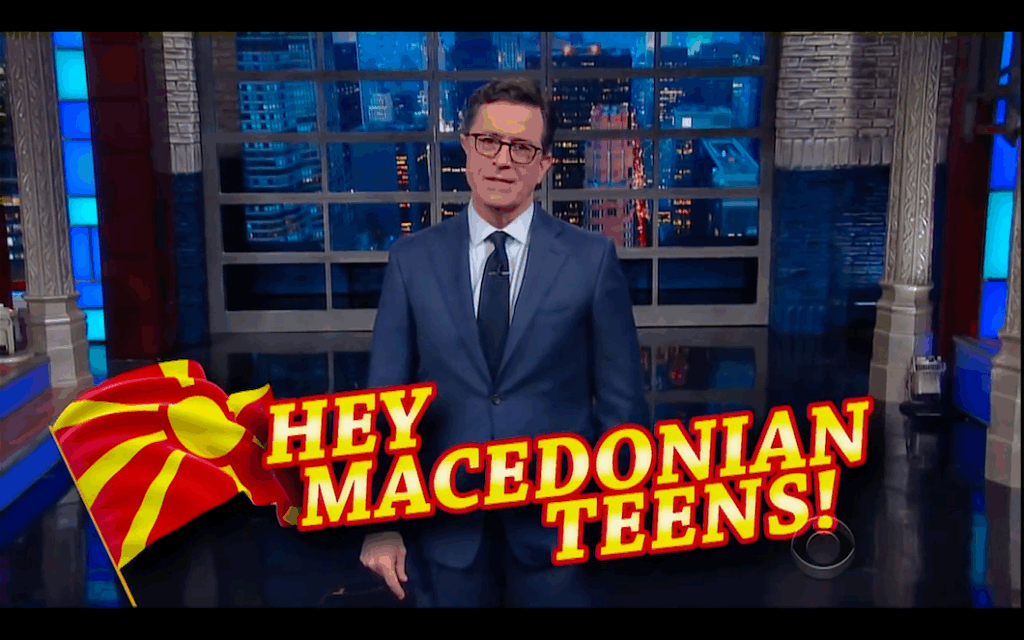
Rumor has it that the breakthrough came with a share in a random Facebook group gathering American users with right-wing views. The share led to one of the websites created in Veles. The content of the shared text was copied from a small American anti-Clinton blog focused on defaming the candidate, and well, not necessarily fact-checked. Within one night, users shared it dozens of times. For the site owner, this meant earnings equivalent to half of the average monthly income in Macedonia.
That’s how Veles became a fake news factory. Buzz about the new great business idea spread quickly, and along with them, the number of websites registered in the Macedonian center grew. The „entrepreneurs” quickly realized that political content attracted more unique users (UU), which meant better earnings. They also discovered that potential Trump voters shared news more often without checking the source. Clinton voters, and even more so Sanders supporters, were skeptical of content from unknown sites with unidentified sources, even if they agreed with the views and supported their candidate.
The mechanism was simple. So-called „Macedonian teens” copied content that could appeal to conservative audiences. Over time, to further increase the likelihood of shares, they started adding something of their own to the copied news. They created sensational, controversial content — fabricating facts, making up catchy headlines, citing nonexistent witnesses.
In this way, in a town of 55,000 residents, more than a hundred websites supporting Trump and smearing Hillary Clinton were registered — among others, repeating false information about an ongoing criminal case against her.
In 2016, the average salary in Macedonia was just under $370. Income from fake news websites ranged from several to more than a dozen times that amount. Gossip goes that the top earners in the last quarter before the elections made even tens of thousands of dollars. All of this came from ads clicked on by users visiting the sites full of sensational articles.
It’s not about beliefs, it’s about business
Perhaps if the 2016 election results had been different, Veles wouldn’t have gained such fame. However, Donald Trump’s victory, decided by 78,000 votes, drew the world’s attention not only to the U.S. electoral system.
The election revealed that skillful use of tools provided by companies like Facebook and Google can have a real impact on shaping voters’ opinions. It turned out that fake news can be a dangerous tool. And that the content of the disseminated messages is not necessarily influenced by the beliefs of their authors, but simply by profit.
An investigation conducted by the Organized Crime and Corruption Reporting Project (OCCRP), supported in part by the United States Agency for International Development (USAID), revealed that the „fake news farms” were not at all an initiative of Macedonian teenagers.
Behind their creation stood… a Macedonian lawyer, Trajche Arsov. To this day, it is not known exactly how much influence Arsov and his American collaborators (including Republican Paris Wade and writer Ben Goldman) had on the election outcome. It has also not been proven that they were connected to Russian propaganda agents, as was initially suspected.
When asked about the motives behind his actions, Arsov told journalists that neither he nor, presumably, any of his followers intended to influence American politics. It was purely about business.
The Man Who Helped Trump Win the Election
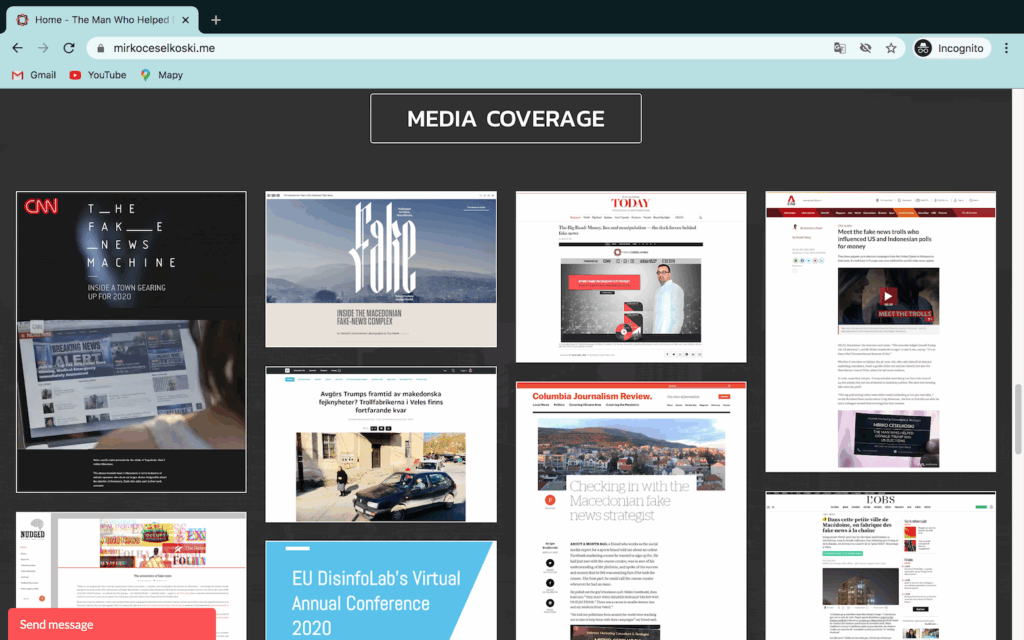
Lawyer Arsov, in interviews, emphasized that no Macedonian law was broken. Mirko Cheselkoski, cited by CNN Money, shares a similar view.
Cheselkoski is the creator of the “Internet Marketing University.” On his website, he openly boasts about headlines from CNN, the French L’Obs, and one of Asia’s most popular news channels, CNA. The headlines are far from what an average entrepreneur would want to see when promoting their business: “Meet the Fake News Trolls Who Influenced the US Election,” “Money, Lies, and Manipulation—The Dark Forces Behind Fake News,” “The Macedonian Fake News Scam,” and so on. The site promotes a course designed to help students create so-called viral content and run Facebook fan pages that can bring in up to $7 million per month. Cheselkoski doesn’t teach how to promote business on social media—sensational content circulating there is the business itself.
In a TV interview for CNA, Mirko Ceselkoski proudly shows his business card. The caption under his name reads: The man who accidentally helped Donald Trump win the 2016 election.
With similar pride, he tells journalists that at least a few of his students were among the creators of pages that may have contributed to Trump’s victory in 2016. He believes that thanks to him, some of them became millionaires. And his business didn’t end with Facebook and Google’s mass removal of Macedonian fan pages. On the contrary—the “enterprises” are thriving.
From elections to veterans and Trump Cards
Trajche Arsov was also mentioned in connection with the „hijacking” of the Facebook page „Veterans for Trump” in 2018. His brother allegedly legally purchased this page, although it had previously been supposedly „hijacked” by another entrepreneur from Kumanovo. This matter did not result in an official investigation. Among the administrators of fake pages from Kumanovo were also former members of the Macedonian army and an employee of the Ministry of Internal Affairs. Although disciplinary proceedings were initiated against them, no legal violations were proven.
The US Embassy also did not notice any new troll factories in Macedonia during the last elections. Nevertheless, in Veles after years a new activity has appeared — the sale of so-called „Trump Cards,” i.e., debit cards featuring Donald Trump, offered mainly by sellers from Veles on the Telegram platform. This is part of a broader trend of selling „souvenirs” and cryptocurrencies linked to Trump. It is unknown whether legal steps are being taken against the sellers of these cards.
We pay to be lied to
Mirko Cheselkoski seems to embody the idea „no matter how, as long as they talk.” But what do the residents of Veles think about the dubious and sudden popularity?
One answer may be the opinion of Slavcho Chadiev, who served as mayor of the city until 2017. Quoted by CNN Money, the politician states that fabricating sensational news and making money from ads is not much different from the lies published by journalists. The mayor did not take any actions to cut this activity. „It’s a way to make quick money,” Chadiev told a CNN reporter. He himself could have offered these people a job as IT specialists and a salary equal to a small part of their earnings from fake news.
Regardless of whether we agree with the former mayor of Veles’s view, he raises an important issue. Macedonia has nothing to offer young people. Youth unemployment reaches 25-30%. Many of them leave the country, but many do not have such opportunities. Additionally, according to the Ethical Journalism Network (EJN), out of more than three hundred Macedonian news portals, only about twenty are considered reliable. This opinion is shared by Macedonians themselves. Another Macedonian problem is the lack of regulations governing media activity.
As Aleksandar Stojkovski, a member of a Macedonian NGO focused on information technologies, summarized:
– We pay for the national TV channel to lie to us, so where do you think young people will learn that truth matters?
Where to watch Selling Lies?
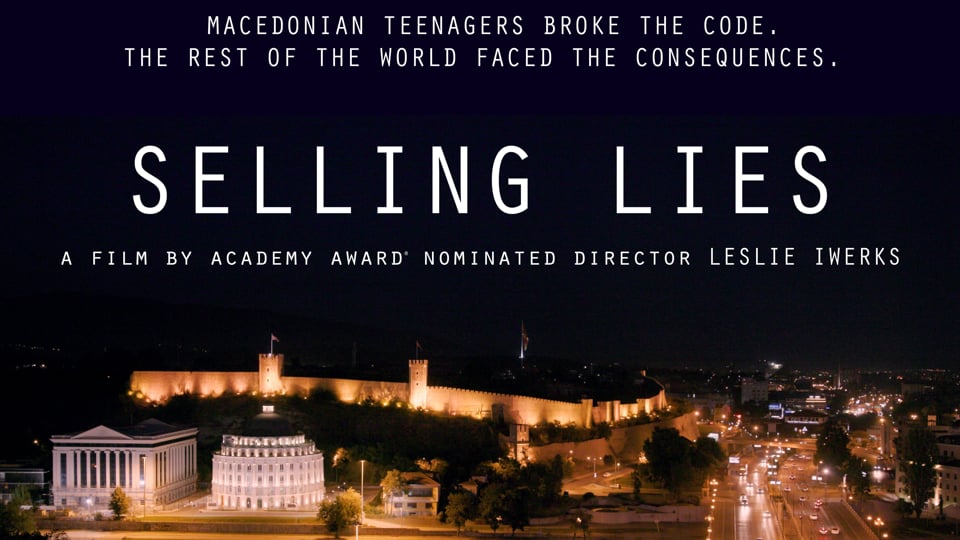
It’s available for rent or purchase on platforms like iTunes, Amazon, Google Play, and Vimeo on Demand—premiered October 9, 2020 (sellingliesdoc.com). As of now, it’s not included in any major subscription service or available to stream for free. Educational licenses for schools or libraries can be purchased via Good Docs (gooddocs.net).
Sources:
In Veles, meeting the producers of fake news, B. Matejčić, European Trade Union Institute (ETUI)
„I was a Macedonian fake news writer”, S. Oxenham, BBC
Inside the Macedonian fake news complex, S. Subramanian, Wired
Fake News: How a Partying Macedonian Teen Earns Thousands Publishing Lies, A. Smith, NBC News
The Fake News Machine: Inside a Town Gearing Up for 2020, F. Davey-Attlee, I. Soares, CNN Money
From Veles with Clicks: For Business of For Politics, I. Illievski, META